
Turicleta
Yeste
Featured Destination

Yeste

Albacete
Cómo llegar

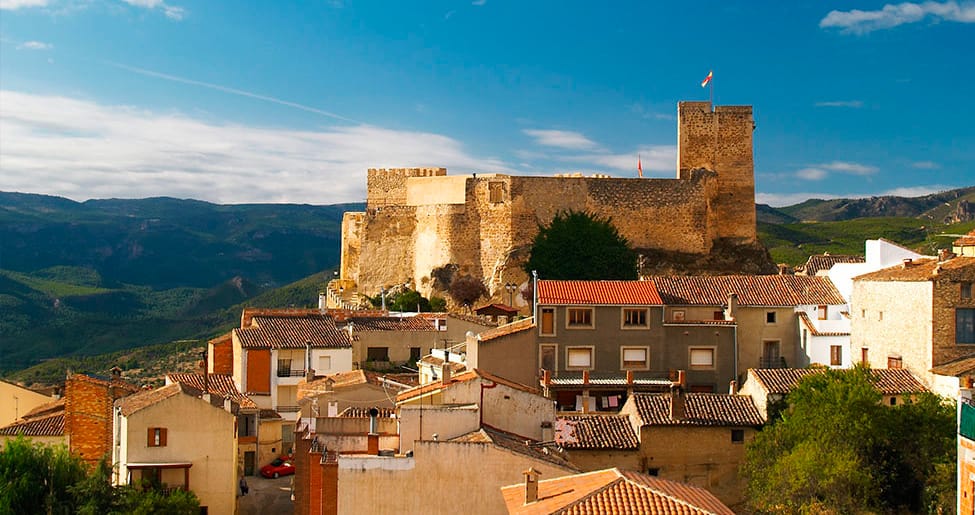
In the westernmost part of the territory, bordering the Andalusian province of Jaén, the town of Yeste is the first to receive the waters of the Segura River. Yeste is a beautiful town that lies nestled on the slopes of the San Bartolomé hill, immersed in a deep and beautiful valley filled with vegetation and natural areas of great importance in this mountain range bathed by the great Segura River and the Tus River. The importance that this Villa once had is evident in a surprising and well-preserved monumental legacy.

2 Cycling Routes
0 stations available

Sobre Yeste

<p><strong>Heritage</strong></p>

Yeste, a town located in the Segura River valley on the slopes of the San Bartolomé hill, surrounded by a landscape of singular beauty, is a town divided into hamlets. A large number of hamlets provide great wealth to Yeste, hamlets that live exclusively from the fields, timber, agriculture, and livestock. The urban center, on the other hand, bases its economy on several more sectors. Within this urban center of Yeste, there are two distinct neighborhoods: the San Juan neighborhood and the Santiago neighborhood.

Yeste is a very peaceful town that boasts very old streets, such as Guerreros, with traditional architecture, narrow and interlaced streets, whitewashed facades, and manor houses that reveal its great historical influence. There are houses with large balconies and windows, some with the family coat of arms on the facade. Beautiful alleys are decorated with flowerpots, such as geraniums, basil, rosebushes, etc. Although new constructions can be seen in the central area of the town that are not very consistent with the traditional style, it is in itself a town with exemplary architecture of a rural area.

The medieval importance of the Villa de Yeste is reflected in a multitude of monuments and places of interest included within the urban center. Of all of them, the robust and well-preserved Castle and the Parish Church of the Assumption stand out as mandatory reference points. The Castle is located on a hill in the center of the town; its construction dates back to the 13th century. It subsequently underwent certain modifications that eventually gave it the appearance we can see today. Despite its age, it is the best-preserved of all those in the Sierra del Segura.

The Church of the Assumption has been declared a Heritage of Cultural Interest. It is a 16th-century temple in which Gothic and Renaissance styles are combined. Inside this temple, we find a carving of the Dolorosa, a work attributed to Francisco Salzillo. Made of polychrome wood using the estofado technique, it suffered damage in 1936 and was later restored. Other monuments are scattered throughout the urban center of Yeste, such as the Hermitage of Santiago (16th century), the Private Chapel of Don Martín Pérez de Ayala, and the Town Hall building of Renaissance design. Cava and Guerreros streets are essential for a walk, as the renowned Casa del Vicario is located in the former; in Guerreros street, we find houses that are preserved with their original stately structure and lintelled courtyards. In the surroundings of Yeste, we can enjoy a swim in the Fuensanta Reservoir or the Tus Spa, in the river of the same name.

<p><strong>Fauna and Flora</strong></p>

The fauna and flora of Yeste have great and varied influences, making them very rich and diverse, with around 2,000 species. The mountains in the area are populated with Aleppo Pine (Pinus halepensis), a medium-sized tree that does not usually exceed 20 meters in height. The canopy is usually not dense as it has sparse foliage. Its age is not usually more than 200 years. Its cones have an elongated shape and a thick peduncle. The leaves are thin and flexible, from 6 to 15 cm in length. The Stone Pine and the Black Pine are also present. The entire mountain is filled with aromatic plants such as Thyme, Rosemary, and Lavender. Regarding cultivated trees, Olive and Almond trees are mostly found, among vineyards and others.

Regarding FAUNA, there is the Graellsia Isabelae Butterfly, first discovered by Don Mariano de la Paz in 1849, of which four subspecies have been described. The most characteristic is the Ceballosii, which is deeply linked to the black pine forests, as the caterpillar eats almost exclusively the needles of these pines. Anatomically, it reaches a size of about 10 cm in wingspan, and stands out for its tails on the back of the wings. It offers a striking coloration of resplendent green with ochre edges and venation and a conspicuous central ocellus on each of the wings.

A bird that is very easy to find is the Short-toed Snake Eagle (Circaetus gallicus), whose dorsal plumage is grayish-brown. The lower parts are white with a somewhat brownish throat and chest. Under the tail and wings, there are dark stripes. It has a rounded head, yellow eyes, and white-blue tarsi. The length it reaches oscillates between 63 and 65 cm. It is an eagle with powerful flight; it soars and hovers frequently with its legs hanging. It feeds on reptiles, especially snakes. It nests in large trees and lays a single egg. It inhabits sparsely populated forests, next to open and sunny terrain with more or less pronounced reliefs.

<p><strong>Festivities</strong></p>

  • Arroyo Morote Festival: February 5th to 6th
  • Majada Carrasca Festival: March 19th to 20th
  • Llano de la Torre Festivals: March 26th to 27th
  • Moropeche Festivals: May 14th to 15th
  • San Juan Festival: June 24th
  • Santiago Festivals: July 23rd to 24th
  • Juan Quilez Festivals: August 1st to 2nd
  • Pilgrimage and Festivals of San Bartolomé: August 8th to 27th
  • Claras Festivals: August 11th to 12th
  • Arroyo Sujayar Festivals: August 13th to 14th
  • La Graya Festivals: August 13th to 14th
  • Los Prados Festival: August 19th to 21st
  • Villar de Tus Festival: August 27th to 28th
  • Arguellite Festivals: October 11th to 12th
  • Traditions Fair: October 28th to 31st
  • Cortijo de la Juliana Festivals: October 29th to 30th
  • Boche Festivals: November 12th to 13th